
Curiosity about PRP hair restoration rarely starts with the science. More often, it starts with a single word: blood. It might sound like a surprising ingredient for an aesthetic treatment, but it’s one of the most powerful. If you have questions about how the treatment works and whether it may be able to help you, you’re in the right place.
At Balle Bliss Luxury Medical Spa in Cypress, TX, Dr. Guljeet K. Sohal has walked patients through exactly what happens between a blood draw and visible regrowth using PRP hair restoration. Here is what that path actually looks like, from your first appointment through the months that follow, so you know what to expect before you ever sit down for a consultation.
What Is PRP, Exactly?
Platelet-rich plasma is a concentrated portion of your own blood, isolated to contain a much higher density of platelets than what circulates naturally. PRP hair restoration uses those platelets to deliver your body’s own repair signals directly to thinning follicles.
To create it, a small blood sample is drawn and spun in a centrifuge, separating the plasma from red blood cells. Research indicates that a platelet concentration of roughly two to six times normal blood levels is needed for optimal outcomes. Platelets carry growth factors, so a higher concentration means more signal delivered directly to your scalp.
What Happens During a PRP Hair Restoration Appointment?
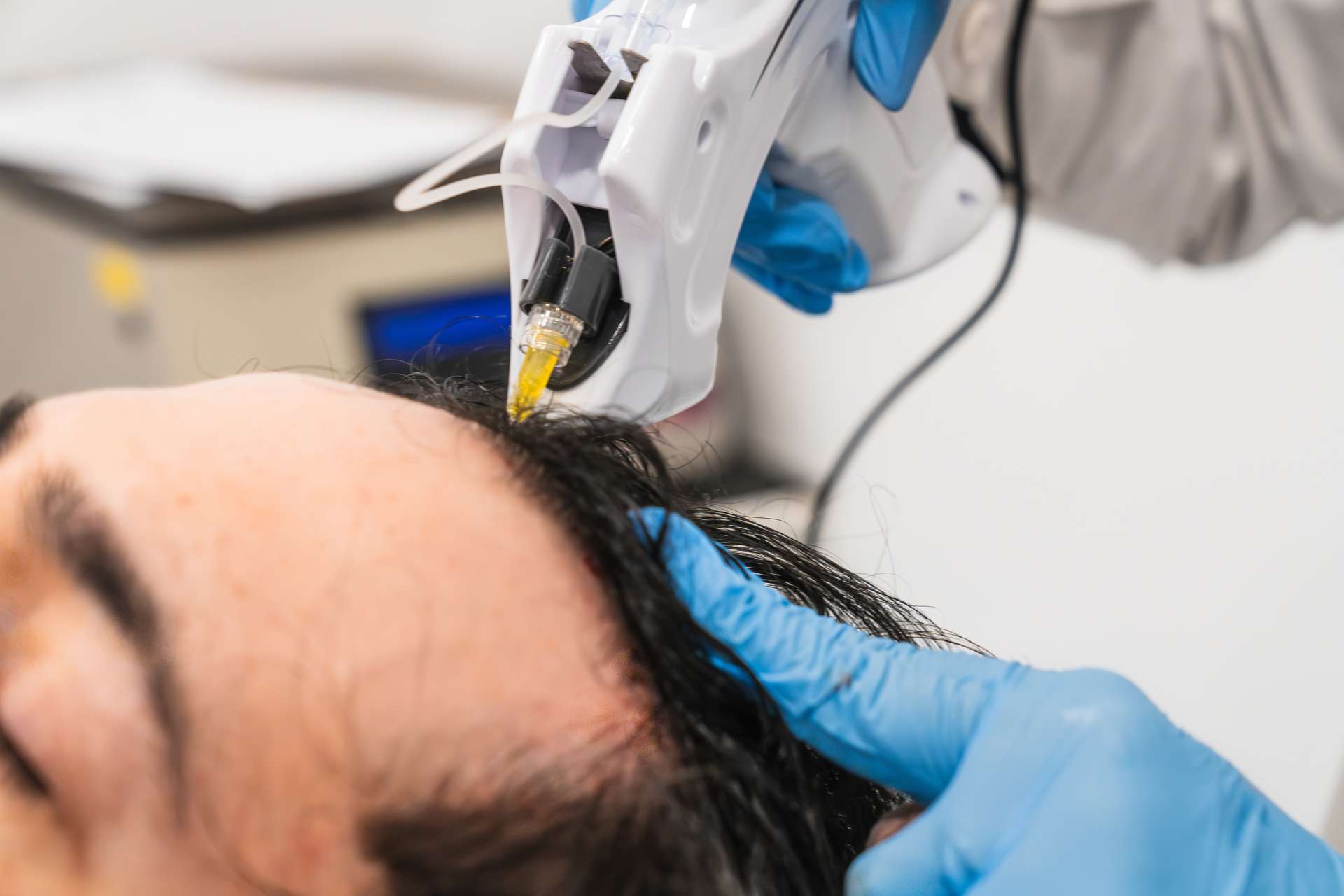
Once your blood has been drawn and processed into plasma, the appointment moves into its final two stages: activation and injection.
Your provider activates the plasma, then injects it directly into the areas of thinning, placed with intention rather than spread evenly across the scalp.
Dr. Sohal maps each injection site based on your own pattern of thinning, not a fixed template. Where the plasma goes determines which follicles receive support, and she handles this step herself as a board-certified physician. A topical numbing agent can be applied beforehand, and most appointments are complete within 30 to 60 minutes.
What Is Happening Inside Your Scalp After Treatment?
After injection, the platelets in the plasma begin releasing growth factors, including epidermal growth factor, vascular endothelial growth factor and fibroblast growth factor, directly into the treated tissue.
These growth factors are what do the actual work. They support the activity of hair follicles that have slowed down or gone dormant, and research shows they help enhance Wnt/beta-catenin signaling, a pathway tied to keeping follicles in their active growth phase longer. This process takes time because it works with your body’s own growth cycle instead of forcing a change on it.
When Do You Start Seeing PRP Hair Restoration Results?
Most patients begin noticing changes within two to three months, with continued improvement over the following months as the hair growth cycle progresses.
Clinical research backs up this timeline. In one randomized, placebo-controlled trial, 20 men received PRP on one half of the scalp and a placebo on the other, with three treatments spaced 30 days apart and outcomes tracked over two years. Researchers observed measurable improvement in the treated areas compared with placebo, reinforcing that consistent, spaced sessions play a real role in the outcome.
Hair grows in cycles, not straight lines, so results tend to appear gradually rather than all at once. Density and thickness typically continue to build for six months to a year as more follicles cycle back into active growth.
How Many PRP Treatments Are Needed For Hair Regrowth?
Most patients need an initial series of three to four sessions, spaced four to six weeks apart, followed by periodic maintenance treatments to sustain results.
The right cadence depends on how advanced your thinning is and how your scalp responds along the way. Dr. Sohal adjusts each patient’s schedule based on what she observes session to session rather than running everyone through the same fixed protocol. Some patients need closer spacing early on, and others taper sooner. Personalized care matters as much in hair restoration as it does in any other treatment at Balle Bliss.
Is PRP Hair Restoration Right For You?
PRP hair restoration tends to work best for patients in the earlier stages of thinning, where follicles are still present but underperforming, more so than in areas of complete, long-term baldness. If you have noticed a widening part, more visible scalp or hair that feels thinner than it used to, PRP may be worth exploring. Results build gradually, using tools your own body already provides.
Patients who choose Balle Bliss for this tend to stay for the long term. More than 80 percent of Balle Bliss patients return for additional treatments, a reflection of how much trust this kind of gradual, personalized care builds over time. Dr. Sohal’s nearly two decades of experience exclusively in aesthetics, including her work training other injectors as a Master Injector, is part of what makes that trust possible.
Start the First Step Toward Fuller Hair With PRP Hair Restoration
PRP hair restoration gives the follicles you already have what they need to do their job again, then gives that process the time it actually takes. There is no way to shortcut the biology, and no real reason to want to. The growth factors already in your blood work at their own pace, which is part of why the results that follow tend to look like your hair, simply fuller.
If you are ready to find out whether PRP fits your hair, your goals and your timeline, schedule a consultation with Dr. Sohal and the team at Balle Bliss Luxury Medical Spa in Cypress, TX. Call (281) 758-2777 or book online today to schedule your PRP hair restoration consultation with Dr. Sohal.